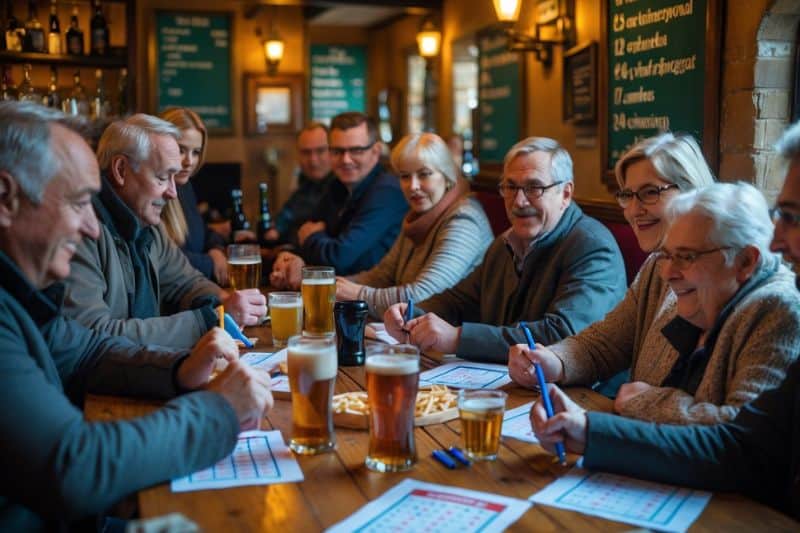
Quizzes have become part of British culture, shifting from simple question-and-answer games to a pastime that spans generations. What began as casual fun in local pubs now includes TV game shows, board games, and digital platforms that connect people around the world.
The journey from traditional pub quizzes in British establishments to today’s online trivia platforms represents one of the most remarkable transformations in social entertainment. These quiz nights, which started gaining traction in the 1970s, have kept their core appeal while adapting to new tech and shifting social habits.
The evolution of quizzes tells a story about how people connect, compete, and learn together. From ancient question-and-answer games used by Greeks and Romans to today’s mobile quiz apps, this tradition keeps bringing communities together through the shared joy of testing knowledge and feeding curiosity.
Key Takeaways
- Quizzes evolved from ancient civilisations’ learning games into modern British pub culture during the 1970s
- Traditional pub quiz nights created a social framework that television shows and board games later adapted for wider audiences
- Digital technology has transformed quizzes from local gatherings into global online experiences whilst preserving their community-building essence
The Birth of Trivia and Early Quiz Traditions
The word “trivia” comes from ancient Roman education, while early quiz traditions started in cosy parlours and social gatherings. These beginnings eventually grew into the pub quizzes and online games we know today.
From the Latin Trivium to Parlour Games
The earliest known appearance of the word quiz dates back to 1782, at least according to historical records. But the roots of trivia go even further back to ancient Rome.
“Trivia” comes from the Latin trivium, which referred to the three basic subjects taught in medieval schools: grammar, rhetoric, and logic. Romans would gather at crossroads called trivia—literally “three ways”—to swap everyday knowledge and local gossip.
Medieval scholars used question-and-answer formats to test students’ understanding. These academic exercises set the stage for modern quiz formats.
Key elements of early trivia:
- Simple questions about common knowledge
- Focus on practical, everyday information
- Social sharing of facts and stories
- Educational testing methods
Early Social Gatherings and Knowledge Challenges
Ancient Greeks, Romans, and medieval scholars used question-and-answer games to challenge each other. These gatherings became popular ways to entertain and learn.
Riddles played a big role in early knowledge challenges. People would toss out puzzling questions at dinner parties and social events.
Greek symposiums featured intellectual competitions. Guests tested each other’s knowledge of philosophy, poetry, and current events.
Medieval courts loved word games and puzzles. Nobles competed to show off their education and wit.
Popular early formats included:
- Riddles and brain teasers
- Poetry competitions
- Debates on current topics
- Memory challenges
Victorian-Era Parlour Entertainment
The Victorian era turned casual knowledge games into structured parlour entertainment. Families would gather in their sitting rooms for quiz sessions in the evenings.
Parlour games became increasingly sophisticated during the 1800s. Published books included hundreds of questions on history, literature, and science.
Middle-class families used these games to show off their education. Parents quizzed their children while entertaining guests.
Popular Victorian quiz formats:
- Twenty Questions – guessing games with yes/no answers
- Charades – acting out words and phrases
- General knowledge rounds – covering multiple subjects
- Literary quizzes – testing knowledge of popular books
These structured games laid the groundwork for modern trivia nights. The social aspect and competitive spirit have stuck around, from those cosy Victorian parlours to today’s online quiz platforms.
The Dawn of Pub Quizzes
The modern pub quiz started in British pubs during the 1970s, turning quiet weeknights into lively competitions. Two marketing professionals saw the potential in organised trivia nights, and the role of the quizmaster quickly became central to the experience.
The Rise of Quiz Nights in British Pubs
In the 1970s, British pubs struggled to attract customers during slow weeknights. Organised quiz nights offered a clever solution that would soon revolutionise pub culture.
Pub quizzes started in the late 1970s as a business strategy. Pub owners needed a way to boost revenue when foot traffic was low.
The concept spread quickly across the UK. What began as simple question-and-answer sessions soon turned into structured competitions that drew regular crowds.
Quiz nights usually featured questions on history, literature, science, and pop culture. Teams would huddle around tables, pooling their knowledge to tackle tough questions.
The format caught on because it combined two British favourites: socialising at the local pub and showing off what you know. This winning combo sparked a tradition that still thrives today.
Sharon Burns and Tom Porter: Pioneers of the Pub Quiz
The commercial success of pub quizzes goes back to two innovators who saw the value in organised trivia entertainment.
Burns & Porter Associates invented the pub quiz in the late 1970s. Sharon Burns and Tom Porter designed this concept to help pubs fill seats during slow nights.
Their company offered a structured approach to quiz nights. Instead of making pub landlords write their own questions, Burns & Porter Associates delivered professional quiz packages.
This approach included:
- Pre-written questions on a mix of topics
- Answer sheets for easy marking
- Guidelines for running quiz nights
- Marketing materials to promote the events
This business model worked because it solved a real problem for pub owners. Burns and Porter provided ready-made entertainment with little prep, and it delivered reliable results.
Their innovation turned what might have been informal trivia sessions into professional events that customers could count on each week.
The Role of the Quizmaster and Quizmasters
The success of any pub quiz rested on the person asking the questions and managing the evening.
In the UK, quiz nights are run by quizmasters rather than trivia hosts. This title means something special in British quiz culture and signals the authority figure who runs the night.
A skilled quizmaster needed a few key qualities:
- Clear speaking voice for reading questions
- Strong personality to keep teams engaged
- Quick thinking to handle disputes
- Good timing to keep things moving
The quizmaster’s job went beyond just reading questions. They set the mood, managed team dynamics, and kept things fair.
Many quizmasters developed their own style. Some stuck to strict rules, while others went for a relaxed, funny approach that encouraged banter between teams.
The relationship between quizmaster and participants became a big part of the pub quiz experience. Regulars developed friendly rivalries and looked forward to the weekly challenge their local quizmaster delivered.
Structure and Social Life of the Traditional Pub Quiz
Traditional pub quizzes created a special social atmosphere, bringing people together through structured competition and shared knowledge. These weekly gatherings built rituals around team formation, question formats, and friendly rivalry that shaped British social life.
How Trivia Nights Became a Social Tradition
Burns & Porter Associates invented pub quizzes in the late 1970s to help pubs fill seats on quiet nights. What started as a business move quickly became a social ritual.
The format was simple and brilliant. Locals gathered on the same night each week, forming teams with friends, family, or even strangers. These weren’t just casual games—they had rules and structure.
Over 10,000 teams joined pub quizzes within just a few years of their debut. The appeal came from mixing two British staples: having a drink and being right about something.
Teams built weekly rituals around the quiz. Many groups met for dinner beforehand or stuck around for drinks after. Regulars became familiar faces, and a sense of community grew beyond the quiz itself.
Popular Rounds, Infinite Bounce, and Team Dynamics
Traditional pub quizzes followed familiar formats that participants could count on. The structure usually included general knowledge, music rounds, picture rounds, and specialist topics.
The infinite bounce format let teams pass questions they couldn’t answer to others. This kept everyone involved, even when the questions got tough.
Team dynamics really mattered. Most teams had four to six members with different strengths:
- The sports enthusiast
- The music lover
- The history buff
- The science expert
Picture rounds stood out because they encouraged teamwork. Team members huddled together, whispered guesses, and debated answers. These moments built the social bonds that kept people coming back.
The quizmaster kept the atmosphere lively. They’d announce answers with a bit of drama, toss out jokes, and handle disputes with a smile.
Evolution of Prizes and Competition
Early pub quiz prizes were modest but meaningful. Winners might get £20 behind the bar or a bottle of wine. Bragging rights and the thrill of winning were the real rewards.
As quizzes took off, competition heated up. Teams developed strategies and even recruited new members to cover their weak spots.
Prize structures changed to keep things interesting:
- Weekly winners scored small cash prizes
- Monthly champions landed bigger rewards
- Annual tournaments offered serious prizes
Organised quiz leagues emerged, with some running for over 20 years. These leagues created rivalries between pubs and teams, adding another layer of excitement.
The competition never drowned out the social side. Even losing teams enjoyed the night out, the mental workout, and the laughs with friends and neighbours.
Quiz Shows and the Rise of Televised Trivia
Television turned simple question-and-answer games into cultural events that captured millions of viewers. From early radio shows to high-stakes millionaire contests, these programmes created household names and changed how families spent their evenings together.
Early Radio and Television Quiz Shows
Radio quiz programmes set the stage for television’s trivia boom in the 1940s and 1950s. Shows like “Twenty Questions” and “Information Please” proved audiences loved testing their knowledge alongside contestants.
Early television quiz shows in the UK started with basic sets and simple formats.
Programmes such as “The Sky’s the Limit” offered modest prizes like a few pounds or gift hampers.
The format was simple but worked well. Contestants answered questions while viewers played along at home.
These shows created a shared experience, bringing families together around the television set.
Producers quickly noticed quiz shows were cheap to make and drew big crowds. The blend of education and entertainment hooked both broadcasters and viewers.
The Jeopardy! Phenomenon
Jeopardy! flipped the traditional quiz show format on its head. Instead of asking questions, contestants had to give questions to provided answers.
The show’s “answer-and-question” style challenged viewers in a new way. Even simple facts felt fresh and a bit more exciting.
Key Jeopardy! innovations:
- Answer-and-question format
- Categories covering diverse topics
- Daily Double wagering system
- Tournament-style special episodes
The host became just as famous as the format itself. Viewers built personal connections with presenters who guided them through each episode’s twists and turns.
Who Wants to Be a Millionaire? and Other Blockbusters
Who Wants to Be a Millionaire? shook up the genre when it launched in 1998. The show offered prize money that earlier quiz shows couldn’t even dream of.
Its dramatic presentation—moody lighting, tension-building music, and the iconic “Is that your final answer?”—created suspense that kept everyone glued to their screens.
Millionaire’s key features:
- Lifelines: Phone a Friend, Ask the Audience, 50:50
- Escalating difficulty: Questions got harder as the game went on
- Safety nets: Guaranteed payouts at certain milestones
- Time pressure: Added extra drama
The show’s success led to a wave of blockbuster quiz programmes. Formats like “The Weakest Link” and “Deal or No Deal” followed Millionaire’s high-stakes, dramatic template.
Quiz shows became prime-time hits, not just daytime fillers. The mix of knowledge, strategy, and psychology made for gripping television that appealed to viewers of all ages.
From Board Games to Trivial Pursuit and Beyond
Board games brought trivia right into British living rooms, turning casual fun into competitive family showdowns. The runaway success of Trivial Pursuit in the 1980s sparked a national obsession with testing knowledge at home and in local clubs.
The Trivial Pursuit Craze
Trivial Pursuit became a cultural phenomenon after big board game companies rejected it at first.
The game eventually outsold Monopoly, showing Britain’s huge appetite for trivia games.
Players moved around a wheel-shaped board, landing on spaces that determined their question category. The six coloured categories included history, science and nature, sports, entertainment, art and literature, and geography.
What made it special:
- Questions ranged from easy to surprisingly tough
- Families of all ages could play together
- It rewarded years of random knowledge
- Collecting those tiny plastic wedges felt oddly satisfying
Sunday afternoons changed once Trivial Pursuit landed in British homes. Grandparents suddenly became valuable team members, their decades of experience finally paying off in family battles.
The game’s popularity led to countless editions and spin-offs. From junior sets to themed releases, publishers realised trivia had found its sweet spot.
Board Games at Home and Club Events
Community centres and church halls embraced trivia board games throughout the 1980s and 1990s. These venues hosted regular games nights where locals could socialise and flex their brains.
Popular venues included:
- Women’s Institute meetings
- Retirement community centres
- Local libraries
- Bridge clubs
Many clubs made up their own house rules and ran tournaments. Teams formed among neighbours and friends, sparking friendly rivalries that sometimes lasted for years.
Board games offered something pub quizzes couldn’t—a chance to pause, chat, and really think about tricky questions. Players liked having the game pieces out on the table, which made for a more relaxed vibe than the pressure of a pub.
Home play stayed popular too, with plenty of families making trivia nights a regular kitchen table tradition.
Online Quizzes and the Digital Evolution
The internet changed the game for quiz fans, moving classic pub nights onto computer screens and mobile phones. Digital platforms transformed traditional trivia into interactive experiences that connect players from all over, while new apps and podcasts gave people fresh ways to test themselves at home.
The Rise of Online Trivia and Virtual Nights
The internet age transformed trivia forever when web-based quizzes popped up in the 2000s.
Suddenly, enthusiasts could play from their sofas instead of trekking to the local pub.
Online platforms made trivia more accessible than ever. No one had to worry about closing times or lousy weather getting in the way of their weekly fix.
Key changes included:
- 24/7 access from anywhere
- Instant scoring and results
- Wider range of topics and difficulty
- Global player pools
Virtual quiz nights became especially popular in the 2010s. Families spread out across cities could finally compete together again.
Many platforms added chat and video features, so players could still enjoy the social buzz that made pub quizzes so beloved in the first place.
Trivia Apps, Podcasts, and New Platforms
Smartphones totally changed how people do quizzes every day. Trivia apps turned waiting for the bus or sipping tea into a quick brain workout.
Popular apps offer all sorts of formats. Some focus on daily challenges, others on longer quiz sessions.
Many include categories that older players enjoy—classic films, history, vintage music, that kind of thing.
Podcasts brought a new twist to the quiz world. Listeners can play along at home, pausing when they need to think. Plenty of shows have nostalgic themes, which seem to click with mature audiences.
Modern platforms offer:
- Personalised difficulty
- Progress tracking
- Social sharing
- Themed content libraries
These digital tools keep the mental challenge of classic quizzes, just with more convenience. Players can grab a quick brain teaser or settle in for a longer session, depending on their mood.
Hybrid Events and the Global Community
Modern quiz culture blends online and offline experiences in ways that feel surprisingly natural. Local pubs use tablets and apps during live events now.
This mix keeps the classic pub vibe but adds digital convenience. Technology integration allows friends from different locations to join the same quiz night.
Grandchildren living abroad can jump into family quiz traditions through video calls and shared apps. Suddenly, distance doesn’t matter as much.
Hybrid features include:
- Live streaming of pub quizzes
- Real-time scoring across multiple locations
- Interactive audience participation
- Digital leaderboards
Players join themed events celebrating everything from British television classics to quirky historical anniversaries. It’s a way to connect with like-minded folks around the world.
The social element stays right at the center. Whether you’re chatting with fellow app users or video-calling family during a virtual quiz night, technology just seems to make those human connections a bit easier—not replace them.